Which ARC Edge knife is right for you?
by Nicola Lando


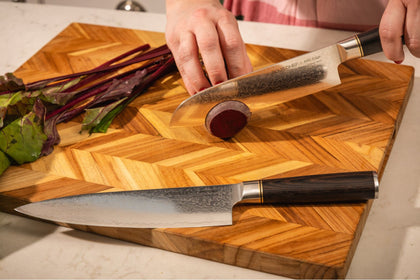
A good kitchen knife should make cooking feel easier. It should glide through an onion rather than skid across it, slice a tomato without squashing it, and feel comfortable enough that you reach for it every day.
When we began developing our own knives, we didn’t want to produce an enormous block filled with shapes most people rarely use. We wanted a small, useful range of remarkably good knives: sharp, beautifully balanced and priced so that you could choose the knives you actually need.
The result is ARC Edge. Four Damascus steel knives, each designed for a slightly different job or style of chopping. Here’s how to decide which one belongs in your kitchen.
If you only want one knife
Choose between the 20cm Chef’s Knife, 18cm Santoku and 15cm Bunka.
All three can handle almost every everyday chopping job, from onions, herbs and vegetables to meat and fish. The important difference is how they feel and move.
- Choose the Chef’s Knife if you like a larger blade and chop with a rocking motion.
- Choose the Santoku if you prefer a flatter blade and a straighter up-and-down chopping action.
- Choose the Bunka if a full-sized knife feels a little too large, or you want one compact knife that can chop, slice and handle more precise work.
None of these knives should be used on bones or frozen food.

The Chef’s Knife: the classic all-rounder
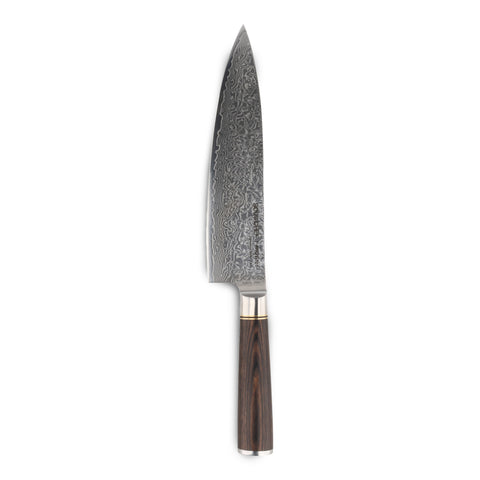
The ARC Edge Chef’s Knife has a 20cm blade: the standard size for a classic chef’s knife and the shape most of our customers naturally choose.
The curved cutting edge lends itself to a smooth rocking action. Use it to work quickly through a pile of herbs, chop onions, prepare vegetables or portion meat. Its narrow, pointed tip is useful when you need more control, whether you’re scoring aubergines or making a precise cut.
This is the knife I would recommend if you want one traditional kitchen workhorse and feel comfortable using a larger blade.
The Santoku: for a straighter chopping action
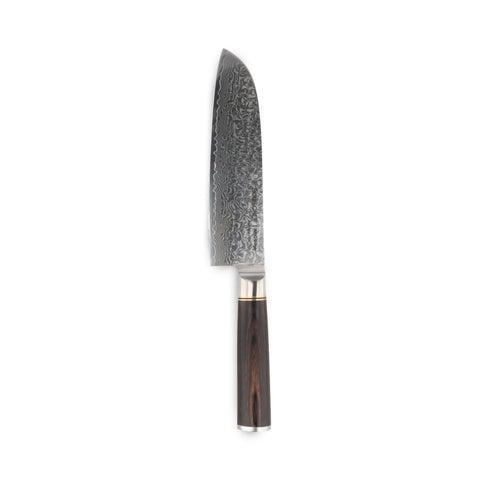
The ARC Edge Santoku Knife is slightly shorter at 18cm, with a flatter cutting edge than the Chef’s Knife.
Rather than rocking the blade backwards and forwards, a Santoku naturally suits a straighter downward or push-chopping motion. It is particularly satisfying for chopping and dicing vegetables, shredding leafy greens and slicing meat or fish.
It does much the same work as the Chef’s Knife. You don’t need both; the decision is largely about which chopping action you prefer. But if you cook frequently and enjoy using different blade shapes, having both gives you that choice each time you reach for the knife rack.
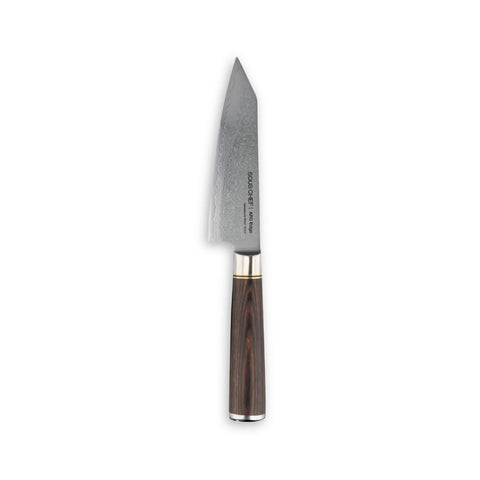
The Bunka: compact, agile and unusually versatile
The ARC Edge Bunka Knife is the smallest of the three everyday knives, with a 15cm blade.
Its shape sits somewhere between a Chef’s Knife and a Santoku. The blade has enough curve to rock comfortably, but it also works well with a straighter up-and-down chop. The sharply angled tip gives you excellent control for scoring, trimming and finer slicing.
Kristin, our cookware specialist who designed the range, had a very particular cook in mind when she added it. Her mother finds an 18cm Santoku or 20cm Chef’s Knife too large, but a 9–10cm paring knife too small for everyday preparation. The Bunka fills that gap.
It’s a very useful knife if you prefer a shorter blade. It also makes an excellent second knife alongside a larger Chef’s Knife, taking over whenever the 20cm blade feels unnecessarily big for the job.
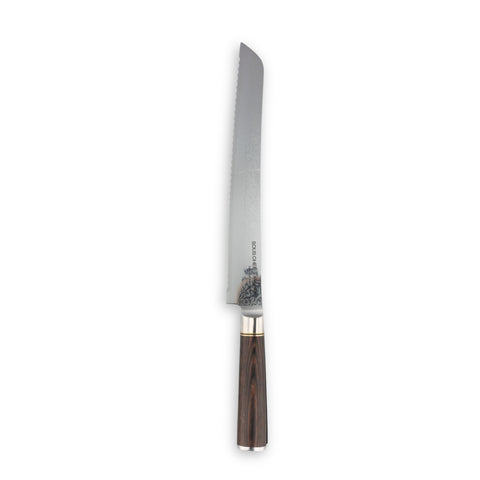
The Bread Knife: long enough to do its job properly
A bread knife needs length. Sawing through a sourdough loaf with a short blade is awkward, and too much downward pressure crushes the crumb you are trying to preserve.
The ARC Edge Bread Knife has a long 25.5cm serrated blade, giving you room for a smooth sawing motion through sourdough, baguettes, brioche and focaccia.
That extra length is useful beyond bread. It can slice neatly across most 9- or 10-inch cakes, and is especially helpful for levelling sponge cakes before filling and icing them.
If your current bread knife drags, sheds crumbs everywhere or compresses the loaf before it cuts, this is the one to replace it with.
What makes ARC Edge knives different?
The performance starts at the centre of each blade, with a powdered steel core that can take and hold an exceptionally fine edge.
Around that core are 73 layers of Damascus steel. These strengthen and protect the blade while creating the rippling pattern that makes every knife beautiful enough to leave on display.
We paid just as much attention to how the knives feel in your hand. Each has a smooth oval pakkawood handle, a curved bolster for comfort around your fingers and a finely sharpened 15-degree edge. The finished knives feel light, controlled and beautifully balanced.
When we first shared them with cooks and food writers, the reactions were pleasingly direct:
“The blade is a thing of beauty, and razor sharp.” — Rhik Samaddar
“It looks and cuts like a dream.” — Helen Goh
“So lightweight, so sharp, so easy to maintain.” — Sophie Wyburd
Because we work directly with the maker, every individual knife in the range costs less than £100. You are paying for the blade and the materials, rather than a famous name stamped onto the side.
Which ARC Edge knife set should I choose?
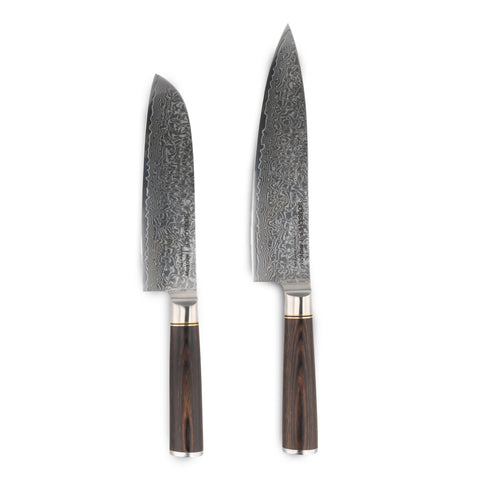
- For two full-sized everyday knives
Choose the Santoku and Chef’s Knife Duo.
This is for cooks who enjoy working with larger blades and want the choice between the rocking movement of a Chef’s Knife and the flatter chopping action of a Santoku.
Bought as a duo, the two knives cost £160 rather than £198 separately, saving £38.
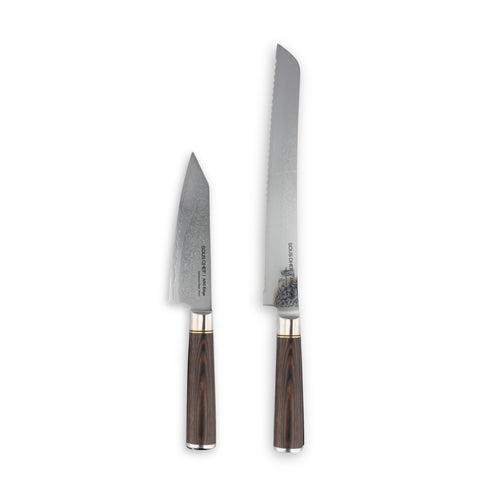
- For a compact everyday knife and a bread knife
Choose the Bread and Bunka Knife Duo.
This pairing makes sense if you prefer a smaller everyday knife, or already own a good Chef’s Knife and want to add two genuinely different blades to your collection. It is also the natural companion to our original Chef’s Knife and Santoku Duo if you would like the complete four-knife range.
The duo costs £150 rather than £188 separately, saving £38.
- For everything you actually need
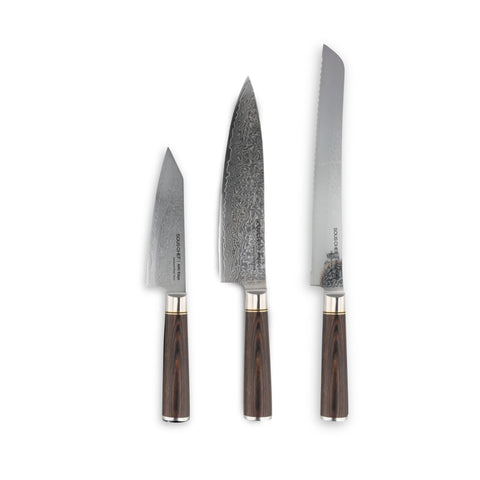
Choose the Bread Knife, Chef’s Knife and Bunka Knife Trio.
If you are starting from scratch, this is the set I would buy.
You have the 20cm Chef’s Knife for larger chopping jobs, the nimble 15cm Bunka for smaller and more precise work, and the long serrated Bread Knife for loaves and cakes. Together they cover almost every normal kitchen task without filling a block with knives you won’t use.
The trio costs £235 rather than £287 separately, saving £52. Unless you later decide you need a specialist boning or filleting knife, you are unlikely to need anything else.
- How to keep your knives sharp
Handwash your ARC Edge knives in warm, soapy water with a soft sponge, then dry them straight away. Don’t put them in the dishwasher, and store them so that the sharp edges aren’t knocking against other utensils.
A simple test tells you when a straight-edged knife needs sharpening: if it can no longer cut easily through the skin of a tomato, it’s time to return it to the stone.
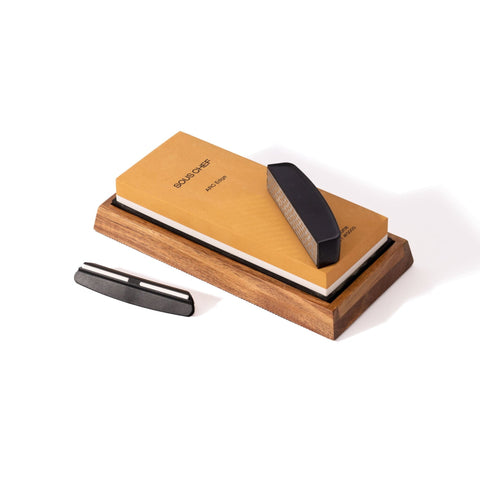
The ARC Edge Combination Whetstone has one side to restore the edge and a finer side to hone and polish it. It comes with a non-slip bamboo base and a clip-on guide to help you hold the blade at the correct 15-degree angle.
Add the whetstone to your basket with an ARC Edge knife and you’ll automatically receive 20% off the stone.
In a nutshell:
- If you usually use a rocking chop, buy the Chef’s Knife.
- If you prefer chopping straight down, buy the Santoku.
- If large knives make you feel clumsy or uncomfortable, buy the Bunka.
- If you are replacing your whole knife collection, buy the Chef’s Knife, Bunka and Bread Knife Trio.
And if you are buying a knife without being able to hold it first, there is some reassurance: use it at home and, if it isn’t right for you, return it within 30 days for a straightforward refund.


About the author
Nicola is co-founder and CEO at Sous Chef. She has worked in food for over ten years.
Nicola first explored cooking as a career when training at Leiths, before spending the next decade in Finance. However... after a stage as a chef at a London Michelin-starred restaurant, Nicola saw the incredible ingredients available only to chefs. And wanted access to them herself. So Sous Chef was born.
Today, Nicola is ingredients buyer and a recipe writer at Sous Chef. She frequently travels internationally to food fairs, and to meet producers. Her cookbook library is vast, and her knowledge of the storecupboard is unrivalled. She tastes thousands of ingredients every year, to select only the best to stock at Sous Chef.
Nicola shares her knowledge of ingredients and writes recipes to showcase those products. Learning from Sous Chef's suppliers and her travels, Nicola writes many of the recipes on the Sous Chef website. Nicola's recipes are big on flavour, where the ingredients truly shine (although that's from someone who cooks for hours each day - so they're rarely tray-bakes!).