Made in Japan - What Makes Japanese Tableware Different
by Lilly Bouldin


Japanese tableware is famous around the world for its craftsmanship, distinctive glazes and the close relationship between the plate and the food served on it.
From deep ramen bowls to small dishes for pickles and long plates for grilled fish, different shapes have different purposes.
And with centuries-old ceramic traditions such as Mino and Kutani still being made today, there’s an enormous variety of colours, patterns and finishes to choose from.
Here’s our ultimate guide to everything that makes Japanese tableware different, and how to choose the right pieces for your table.
Browse all Japanese Tableware, or read everything you need to know about ramen bowls
What is special about Japanese tableware?
Japanese tableware has a particularly close relationship with the food that goes onto it. Traditional Japanese table settings use different bowls and dishes for different parts of a meal.
Rice might have its own bowl. Soup another. Pickles arrive on something smaller again. A grilled fish might sit across a long rectangular plate in the middle of the table. That relationship between dish and food explains why there are so many shapes and sizes to discover.
Artisan Glazing
The surface of Japanese ceramics can be just as interesting as the shape.
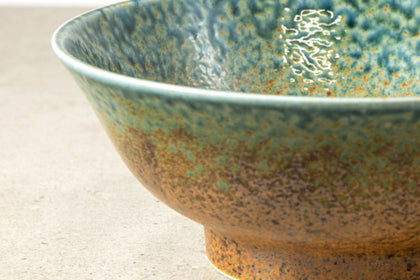
Some glazes look wonderfully restrained until they’re seen up close. What appears to be one colour can contain several: greens moving into blue, red-brown gathering around the edge, white or sandy tones appearing where the glaze thins.
Playful Designs
And Japanese tableware certainly doesn’t have to mean restrained browns and greens. There are pieces covered in fish, cats, blossom, waves and bright pattern.
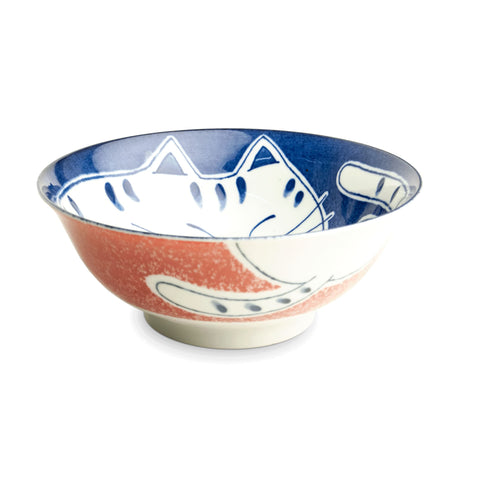
The Orange Lucky Cat Ramen Bowl, for instance, is unapologetically playful in blue and orange. Both approaches belong on the same table.
What are the different types of Japanese bowls and plates?
Quite a lot. Japanese tableware becomes much easier to understand when the question changes from “Do I need a bowl or a plate?” to “What am I eating from it?”
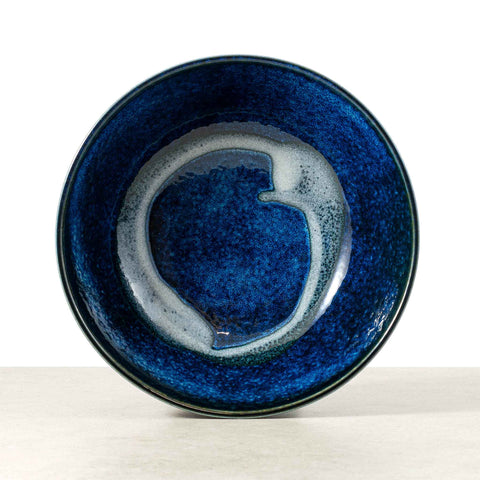
Ramen bowls
These are among the largest Japanese bowls.
They need enough width and depth for broth, noodles and everything balanced on top: egg, pork, spring onions, nori, bamboo shoots.
A classic Sous Chef ramen bowl is around 21cm wide and 8.5cm deep, giving enough room for a full noodle soup without making the bowl awkward to eat from.
The Mizumi Ramen Bowl is a good example. It holds 1.3 litres and has a deep blue multi-tonal glaze.

Noodle bowls
Noodle bowls are usually a little smaller than ramen bowls but still deep enough for udon, soba, wontons, soups and stews.
The Karasuba-Iro Noodle Bowl is 17cm across, compared with the 21cm ramen bowl in the same collection. It’s the same family of glaze, but a different piece because it has a different job to do.
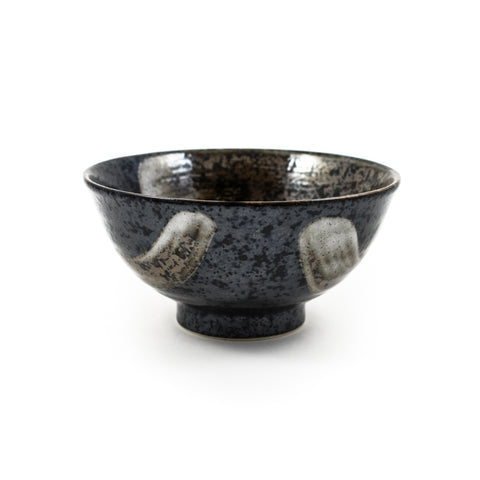
Donburi bowls
Donburi bowls are designed around rice dishes with toppings: rice underneath, then meat, fish, vegetables or egg above it.
Their depth gives enough room for both layers without needing the scale of a ramen bowl filled with broth.
A larger rice bowl such as the Karasuba-Iro Large Rice Bowl also works beautifully for dishes such as oyakodon and bowls of soup.
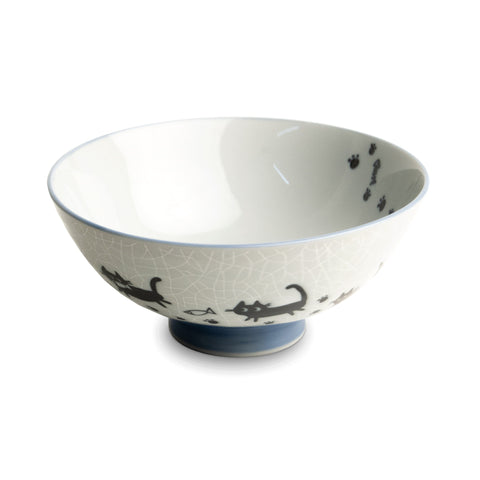
Rice bowls
Smaller again. These are made for individual portions of rice and are among the easiest pieces of Japanese tableware to bring into an everyday kitchen.
They rarely stay confined to rice, either. A bowl that size has a habit of appearing at breakfast, lunch and dinner.

Small bowls and sauce dishes
This is where the table starts becoming interesting.
Small bowls are used for things such as pickles, vegetables, sauces, garnishes and small side dishes.
A little dish makes three slices of pickle look intentional rather than lonely.
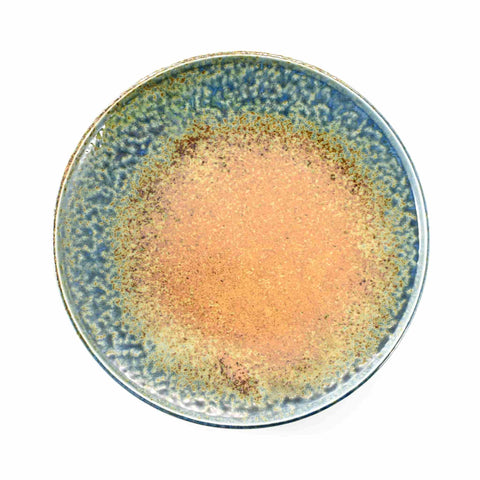
Large serving plates
At the opposite end are dishes made to sit in the middle of the table.
A whole grilled fish. Sliced meat. Fried rice. Something everyone is going to reach towards.
The Chouseki Blue Gold Plate is 28.5cm across: much more a serving piece than an individual side plate.
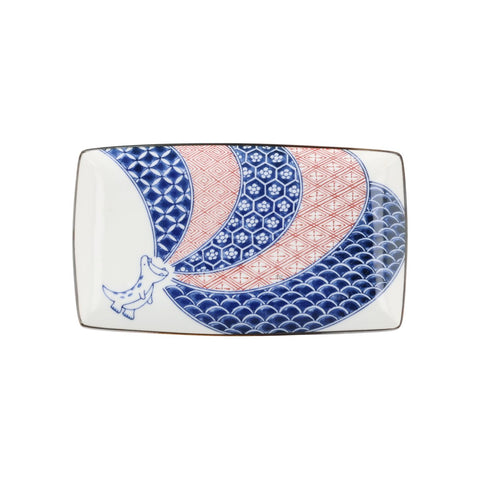
Rectangular plates
One of the most useful Japanese shapes.
The proportions work naturally for sushi, sashimi, grilled fish and yakitori, but they’re just as useful for asparagus, sliced tomatoes, cheese or little cakes.
Serve sushi and gyoza on this rectangular dinosaur plate. It’s decorated with Edo motifs in shades of red and blue. In the bottom corner is a roaring Tyrannosaurus.

Shallow bowls
This is the shape we think almost everyone can use. Not quite a plate. Not quite a bowl.
They’re brilliant for noodles, curries, fried rice, saucy vegetables and anything where an ordinary flat plate leaves you nervously watching the edge.
Use this shallow fish-themed bowl to serve Japanese dishes as part of a sharing-style meal. Place it in the centre of your table for guests to help themselves to unagi (grilled eel) or sakana no nitsuke (fish simmered in soy, mirin and sake).
Why do Japanese plates and bowls come in different shapes and sizes?
Because the vessel is part of presenting the food.
- A broad ramen bowl leaves space for broth and toppings.
- A tiny plate makes a few pickles feel deliberate.
- A long plate follows the shape of a whole fish.
- A shallow bowl contains sauce without hiding everything underneath a deep rim.
Put down rice bowls, several small dishes, a long platter in the middle and a tiny bowl of pickles, and people eat differently. Things are passed. People reach. Different dishes are tasted at different moments.
What is Mino ware?
Mino ware, or Mino-yaki, comes from the historic ceramic-producing region of Gifu Prefecture. It is not one single visual style.
Some Mino ceramics are pale and softly glazed. Others are rich green. Others almost black. Four historic traditions often associated with Mino pottery are Shino, Oribe, Ki-Seto and Setoguro.
- Shino is known for thick, pale glazes, sometimes with a softly uneven surface.
- Oribe brings stronger greens and bolder decoration.
- Ki-Seto tends towards warm yellow and earthy tones.
- Setoguro is known for deep black.
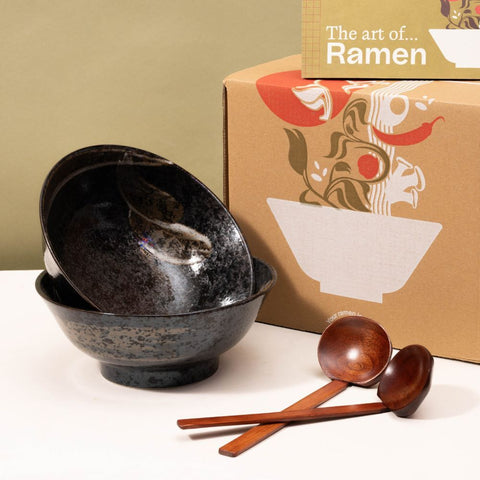
That last style helps explain the appeal of tableware such as Sous Chef’s Karasuba-Iro collection. Its black and grey speckled glaze is interrupted by red-brown and white detailing, so the surface becomes more interesting the closer it’s viewed.
Pieces such as the Karasuba-Iro Small Plate are individually made, so minor changes in colour, pattern and texture occur from one to another.
What is Kutani ware – and what is Seikou?
Kutani-ware takes almost the opposite approach. Where many Mino pieces draw the eye through glaze and restraint, Kutani ceramics are known for decoration.
Shop: find all Seikou Kutani-Ware tableware at Sous Chef
Traditional Kutani work is particularly associated with a vivid palette of red, yellow, green, purple and deep blue, applied over porcelain in detailed designs.
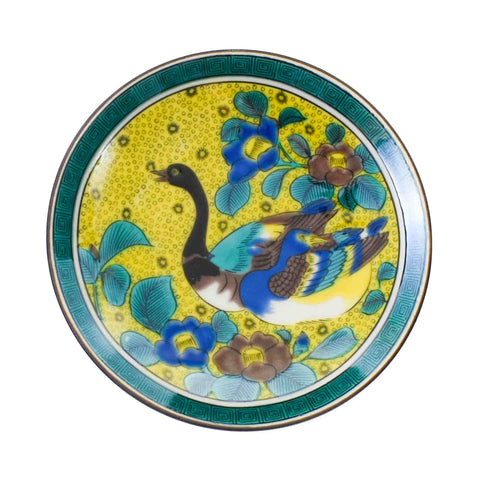

Seikou is not another ceramic style. It is a maker working in the Kutani tradition.
Sous Chef’s Seikou pieces are produced in Ishikawa Prefecture, where the company has made Kutani porcelain since 1935.
What makes the Seikou range particularly enjoyable is the way it carries that decorative tradition into tableware that feels easy to use now.
Traditional colour sits alongside playful motifs. Animals appear. Patterns become brighter or more graphic.
It doesn’t have to feel ceremonial. It can simply be the plate someone reaches for because the rabbit makes breakfast better.
Does Japanese tableware need to match?
Absolutely not. In fact, much of Sous Chef’s Japanese tableware is explicitly intended to be mixed with different colours, patterns and textures.
That freedom is one of its great pleasures. A glossy black plate beside a sandy-blue bowl. A tiny patterned dish next to something completely plain.
One brightly decorated piece amongst three quiet glazes. Food can lead the choice too.
Something pale – a little pickled ginger, tofu or daikon – might be more interesting against colour or pattern.
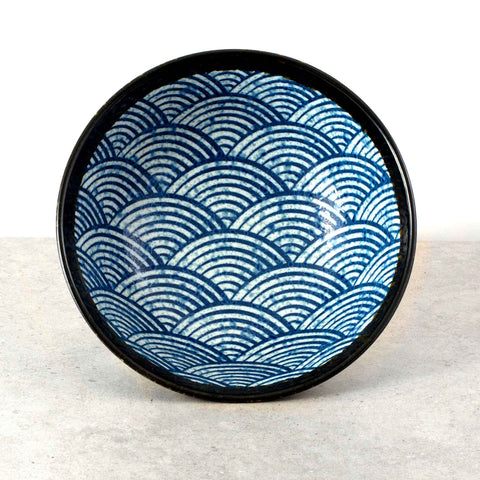
The Blue Wave Ramen Bowl makes the point beautifully: blue and white glaze with a dark border, deliberately designed to be mixed with other pieces at the table.
The table can change with the season as well. Spring might bring out paler glazes and blossom patterns.
In winter, darker bowls and rougher textures suddenly feel right. The cupboard doesn’t need replacing. Just rearranging.
How to choose Japanese tableware?
Think about what actually gets cooked most often. If ramen appears every Friday night, choose a bowl that makes that particular ritual better.
If most meals involve several things in the middle of the table, serving platters and smaller side dishes will probably earn their cupboard space more quickly.
If dinner often means pasta, curry, noodles or rice, a shallow bowl may be the shape that barely makes it back onto the shelf.
Then think about colour. If the food is already vivid, a quieter glaze can give it somewhere to stand out.
If the tableware itself is meant to bring personality, there is no reason to be restrained!
Is Japanese tableware dishwasher safe?
Sadly, there is no useful blanket rule. Whether a piece can go in the dishwasher depends on the clay, glaze, decoration and manufacture of the individual item.
Many of Sous Chef’s glazed Japanese bowls are dishwasher safe. The Yozora Ramen Bowl, Mizumi Ramen Bowl, Karasuba-Iro Ramen Bowl and Chouseki Ramen Bowl, for example, are all listed as dishwasher safe.
But pieces with metallic details or particularly delicate decoration may require hand washing.
Check the care instructions for the individual piece.
It takes ten seconds and is considerably better than discovering six months later that the gold line around a favourite plate is slowly disappearing.
Japanese tableware is meant to be lived with
There are centuries of skill behind Japanese ceramics and distinct traditions in places such as Mino and Kutani.
But none of that means the bowls need to sit untouched on a shelf. Japanese tableware gives food somewhere interesting to live.
And nobody needs to understand every ceramic tradition before being allowed to enjoy it. Start with the piece that keeps catching the eye.
Then put something completely different next to it.


About the author
With a Fine Art background, Lilly has a keen eye for colour, print, and product balance. Her expertise is in kitchen and homewares buying and has worked at some of the biggest brands in the UK.